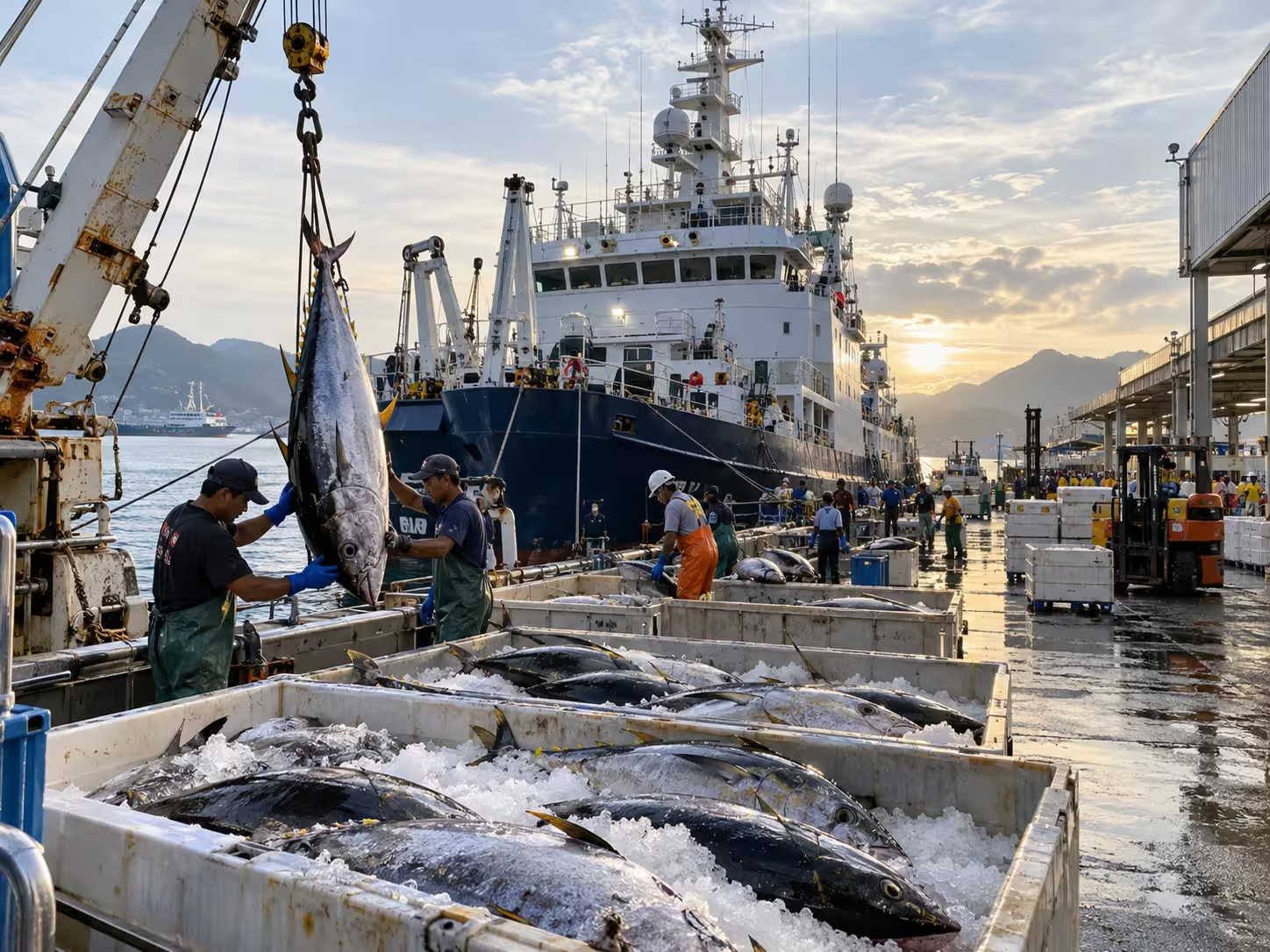
The Digital Dawn of Malaysian Fisheries
Technology is no longer a peripheral concern for Malaysia’s fisheries industry—it has become the central organising principle of the sector’s modernisation agenda. From the deep waters off Miri to the aquaculture ponds of Pekan, a suite of digital innovations is fundamentally altering how fishermen find fish, how farmers monitor livestock, and how regulators manage resources.
The Fisheries Development Authority of Malaysia (LKIM) showcased the vanguard of this transformation at the Malaysia Agriculture, Horticulture and Agrotourism Show (MAHA) 2026, where satellite buoys, boat simulators, and the Meranti Fishermen’s Village concept drew significant attention. LKIM Chairman Muhammad Faiz Fadzil articulated the strategic intent behind these exhibits: “We want the younger generation to understand the conditions at sea and provide an opportunity for visitors to use the technologies that will be provided”.
Satellite Buoys: Precision Fishing Meets Cost Efficiency
The satellite buoy represents perhaps the most immediately impactful technology for capture fisheries. These devices enable fishermen to track fish locations with far greater precision than traditional methods, directly addressing one of the most persistent operational challenges in the industry: the cost of fuel expended during search operations.
The operational economics are compelling. By reducing the time and fuel consumed searching for fish aggregations, satellite buoys can meaningfully lower the cost structure of small-scale fishing operations. This technology is particularly significant for Zone A fishermen, whose margins are often razor-thin and for whom fuel represents a disproportionate share of operating expenses. The Department of Fisheries (DOF) in Sarawak is concurrently developing digital-based Fish Aggregating Devices (FADs) to enhance deep-sea tuna catches beyond Miri waters, demonstrating how traditional fishing techniques are being augmented—rather than replaced—by digital tools.
AI and IoT in Aquaculture: The Smart Farm Revolution
The aquaculture sector is witnessing perhaps the most dramatic technological leap. The National Fishermen’s Association (NEKMAT) is evaluating an investment of approximately RM300,000 to deploy artificial intelligence in its white shrimp farming project in Badong, Pekan. The system would utilise sensors and smartphone applications to monitor water quality, oxygen levels, temperature, and other critical parameters in real time, while also determining feed requirements with greater accuracy based on accumulated farming data.
NEKMAT General Manager Azrin Shah Ismail captured the operational philosophy behind the investment: “We can get more accurate data, thus avoiding food waste and reducing pressure on shrimp. If the power supply goes out, oxygen levels drop or any parameter changes, the system will warn us”. The existing four ponds produced 58 tonnes of white shrimp valued at RM1.4 million in 2025, and the organisation is now constructing nine additional ponds across 15 acres with an investment of RM5 million.
IoT and Solar Integration in Community Aquaponics
The technological modernisation extends beyond commercial aquaculture into community-level food production. The Ministry of Science, Technology and Innovation (MOSTI) is implementing an aquaponics project in Pasir Panjang that integrates solar energy and Internet of Things (IoT) technology to enhance system efficiency and productivity. This initiative, executed through the Malaysian Innovation Foundation under the MyIS Community Programme, demonstrates how renewable energy and digital monitoring can be combined to create resilient, decentralised food production systems.
Human Capital and the Youth Dividend
A recurring theme across these technological initiatives is their potential to attract younger Malaysians to the fisheries sector. Azrin Shah expressed explicit hope that automation and smart monitoring would draw youth and graduates into aquaculture by offering a more modern and organised work environment. The boat simulators showcased at MAHA 2026 serve a parallel function for capture fisheries, providing immersive exposure to maritime working conditions without the risks and costs of actual sea time.
The Department of Fisheries has also emphasised the importance of hybrid solar energy systems and IoT applications for real-time water quality monitoring as prerequisites for operational sustainability in biofloc aquaculture, signalling that technology adoption is being positioned not as optional enhancement but as foundational infrastructure for the sector’s future.
Malaysia’s fisheries technology trajectory reflects a broader recognition that the sector’s competitiveness—indeed, its viability—will increasingly be determined by its capacity to integrate digital tools, data analytics, and renewable energy into traditional practices.
