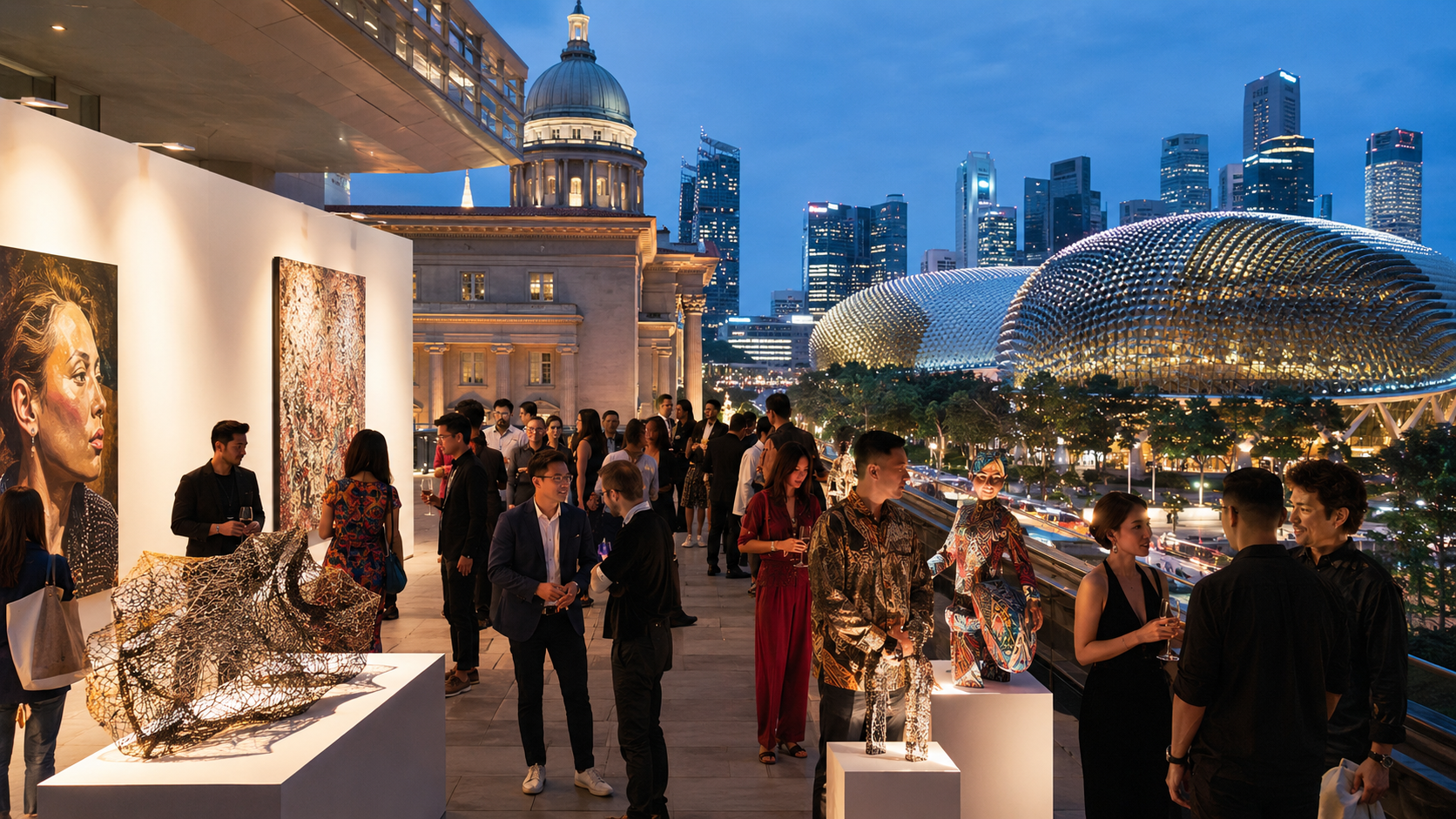
Inside Singapore’s Creative Ecosystem: Why Artists, Galleries and Collectors Continue to Converge in the City-State
Singapore has long been recognised for finance, logistics and international trade. Increasingly, however, the same characteristics that made the country a commercial crossroads are strengthening its position in the arts.
The city-state functions as a cultural connector rather than simply a large domestic market. Artists from Southeast Asia gain access to global audiences, international galleries meet regional collectors, and major institutions present histories that were once underrepresented in the wider art world.
This combination has allowed Singapore to develop one of Asia’s most strategically connected creative ecosystems.
Museums Give Southeast Asian Art Greater Visibility
At the centre of the landscape is a network of institutions capable of presenting both historical and contemporary work.
National Gallery Singapore has helped broaden international understanding of modern art from Singapore and Southeast Asia. Its exhibitions place regional artists within larger historical conversations rather than treating them as peripheral figures in a Western-dominated narrative.
The Singapore Art Museum contributes another dimension by focusing on contemporary practices and new artistic approaches.
Meanwhile, Esplanade – Theatres on the Bay gives performing arts a prominent place in public life. Theatre, dance, music and interdisciplinary programming ensure that Singapore’s cultural identity extends far beyond museums and commercial galleries.
Gillman Barracks adds a different model. By using a former military complex for galleries and cultural organisations, the site illustrates how heritage spaces can be transformed into places for contemporary exchange.
Long-Term Policy Shapes the Art Sector
Singapore’s creative development is closely connected to public investment.
The National Arts Council plays a central role in supporting artistic practice, organisations, education and audience engagement. The Our SG Arts Plan 2023–2027 also provides an ongoing policy framework for widening participation and improving conditions within the arts sector.
Readers seeking official information about Singapore’s arts programmes and national priorities can refer to the National Arts Council at https://www.nac.gov.sg/.
Long-term planning creates stability, but it also raises a significant cultural question. Can an art scene supported by strong institutions remain sufficiently independent, unpredictable and experimental?
The answer matters because the most influential creative centres are not built only through impressive venues. They also require room for disagreement, artistic risk and ideas that may not produce immediate economic returns.
Global Events Strengthen Singapore’s Market Position
Singapore’s international profile has expanded through events such as ART SG and the broader Singapore Art Week programme.
The importance of these events lies in their concentration of activity. International galleries, private collectors, museum professionals, artists and cultural organisations gather in the same city within a limited period.
For Southeast Asian artists, this can create valuable exposure. For overseas collectors and curators, Singapore offers a practical entry point into regional practices from Indonesia, the Philippines, Thailand, Malaysia, Vietnam and beyond.
The model reflects Singapore’s wider economic identity: its value comes from connecting markets and communities.
A Creative Hub Still Evolving
Singapore’s artistic success should not be measured only by visitor numbers, expensive artworks or spectacular museum buildings.
Its greater achievement is the creation of an ecosystem where public institutions, private capital, education and international networks continuously interact.
The challenge ahead is to maintain that momentum without allowing the scene to become overly dependent on large institutions and commercial events. Independent creators and smaller organisations remain essential because they often produce the experimentation that later shapes mainstream culture.
Singapore’s future as an art hub will therefore depend on balance: global ambition combined with local depth, economic opportunity combined with creative freedom, and international visibility combined with genuine support for artists.
