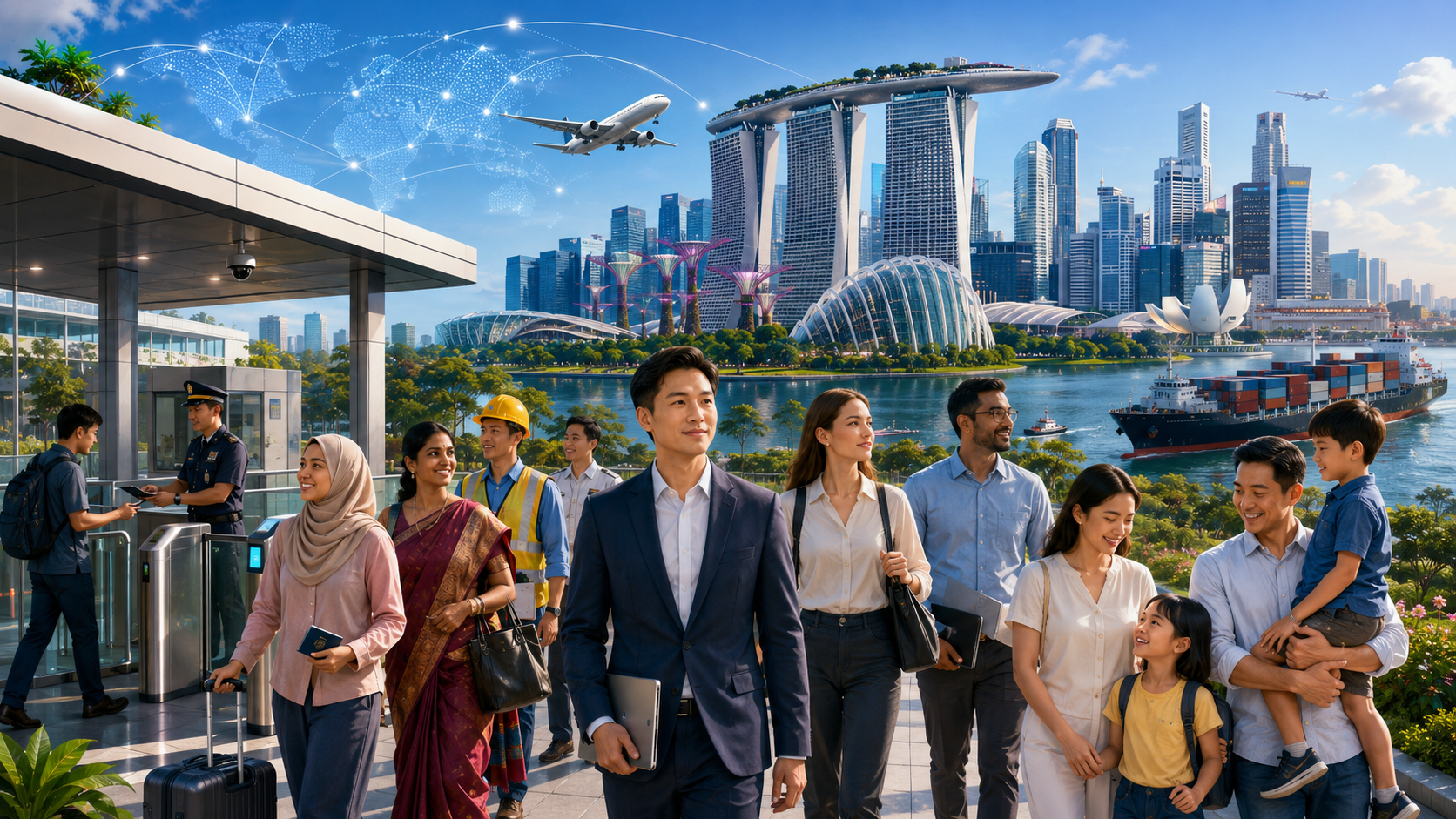
Singapore’s immigration policy is shaped by a central reality: the country is small in land area but highly connected to the world. As a global financial, trade, logistics, and technology hub, Singapore depends on people, skills, and ideas from beyond its borders. At the same time, it must manage limited space, social cohesion, public resources, and national identity. This is why immigration in Singapore is not simply about allowing people to enter the country. It is a carefully designed system that balances economic growth, demographic needs, cultural diversity, and social stability.
One major purpose of Singapore’s immigration policy is to support the economy. The country has a relatively small local population and faces long-term challenges such as an ageing society and low birth rates. To remain competitive, Singapore welcomes foreign professionals, entrepreneurs, researchers, and skilled workers who can contribute to industries such as finance, engineering, healthcare, education, biotechnology, and digital technology. Work passes such as the Employment Pass and S Pass allow companies to hire foreign talent when local skills are insufficient. However, the government also uses salary requirements, qualification standards, quotas, and levies to prevent overdependence on foreign labour.
Another important aspect is maintaining diversity without weakening unity. Singapore is already a multicultural society made up mainly of Chinese, Malay, Indian, and other communities. Immigration adds further diversity through newcomers from Asia, Europe, the Americas, and other regions. This diversity can enrich food, language, business networks, education, and cultural life. Yet the government also recognises that diversity must be managed carefully. Social integration is encouraged through schools, workplaces, community programmes, and public communication that emphasises racial and religious harmony.
Permanent residency and citizenship are granted selectively. The government considers factors such as economic contribution, family ties, length of stay, education, age, and ability to integrate into Singaporean society. This selective approach allows Singapore to attract people who are likely to contribute not only to the economy but also to the country’s long-term social fabric. Becoming a Singapore citizen is not treated as a simple administrative step. It is connected to responsibilities, loyalty, and participation in national life.
Singapore also places strong emphasis on border control and legal compliance. The Immigration and Checkpoints Authority manages entry, visas, residency, and enforcement. Strict rules apply to overstaying, false declarations, illegal employment, and misuse of passes. These controls help maintain public trust in the immigration system. When citizens believe that immigration is regulated fairly and firmly, they are more likely to accept the presence of foreign workers and new residents.
At the same time, Singapore’s policy faces ongoing debate. Some citizens worry about job competition, wage pressure, rising housing demand, and overcrowding. Others argue that immigration is necessary for innovation, tax revenue, and support for an ageing population. The government’s challenge is to keep adjusting policies so that businesses have access to talent while local workers are protected and upgraded through education, training, and fair hiring practices.
Singapore’s immigration policy is therefore both practical and strategic. It protects national interests while keeping the country open to global opportunity. By combining selectivity, integration, economic planning, and strict regulation, Singapore tries to ensure that immigration strengthens the country rather than divides it.
