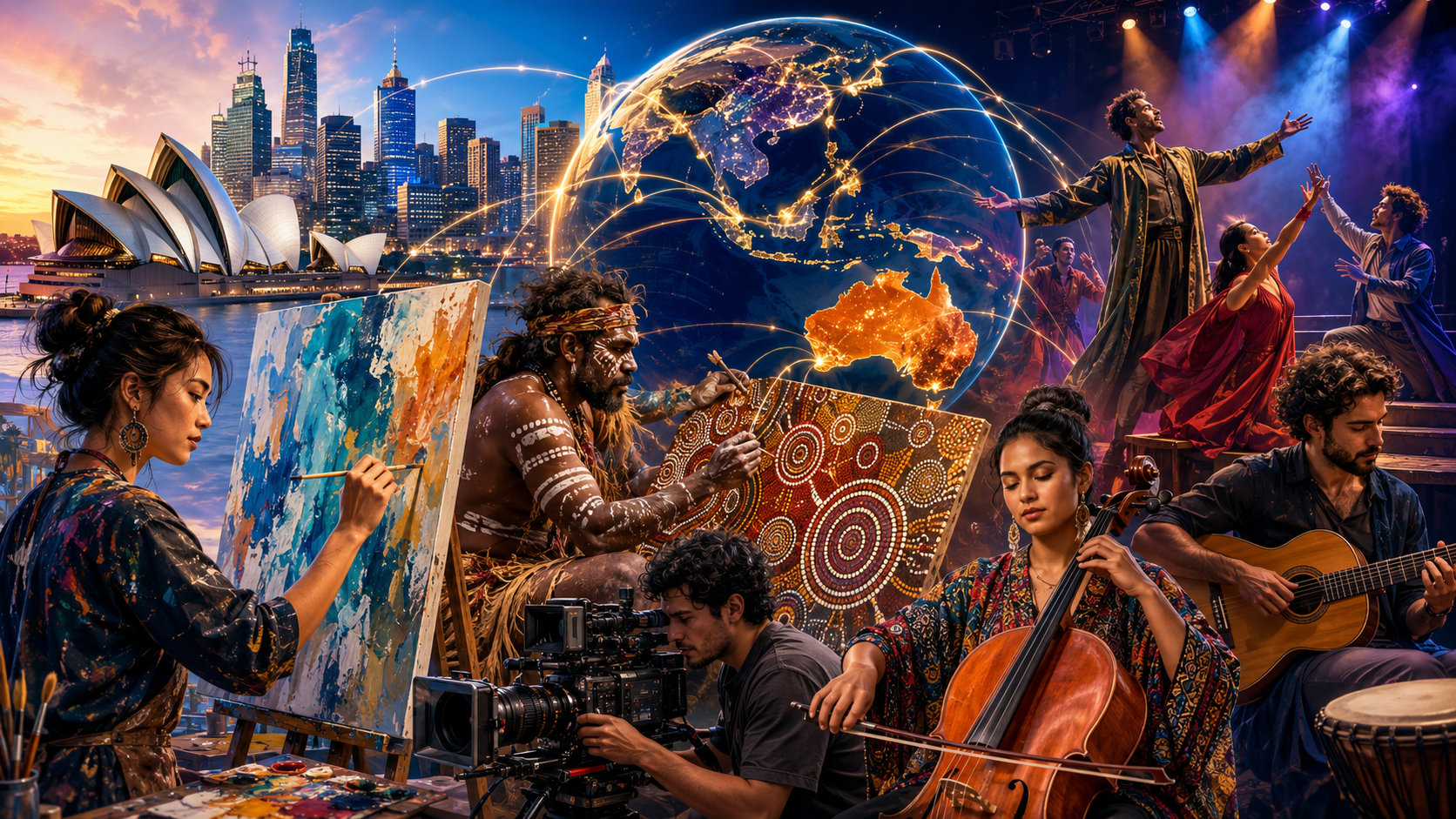
Australia’s visual arts scene has developed through a layered history that reflects both European influence and Indigenous heritage. Early colonial art in the 18th and 19th centuries was heavily shaped by European settlers who documented the unfamiliar Australian landscape. Artists such as John Glover and Eugene von Guérard focused on vast terrains, often romanticizing the land while also capturing its stark uniqueness.
As Australia moved into the 20th century, a more distinct national identity began to emerge in visual arts. The Heidelberg School, often considered Australia’s impressionist movement, introduced a more localized way of seeing light, color, and rural life. Artists like Arthur Streeton and Tom Roberts emphasized outdoor painting and natural Australian light, helping define an early visual language for the nation.
In contemporary times, Australian visual art has become highly diverse and internationally recognized. Modern artists work across painting, sculpture, installation, and digital media. Institutions such as the National Gallery of Australia in Canberra and the Museum of Contemporary Art in Sydney play key roles in supporting both established and emerging artists.
A significant feature of the modern scene is its engagement with global issues. Environmental change, urbanization, and identity politics frequently appear in artistic expression. Australian artists increasingly exhibit in international biennales and art fairs, positioning the country as an active participant in global contemporary art dialogue.
At the same time, Indigenous art continues to be one of the most influential forces shaping Australian visual culture. The integration of traditional symbolism with modern techniques has helped redefine how Australian art is perceived worldwide.
