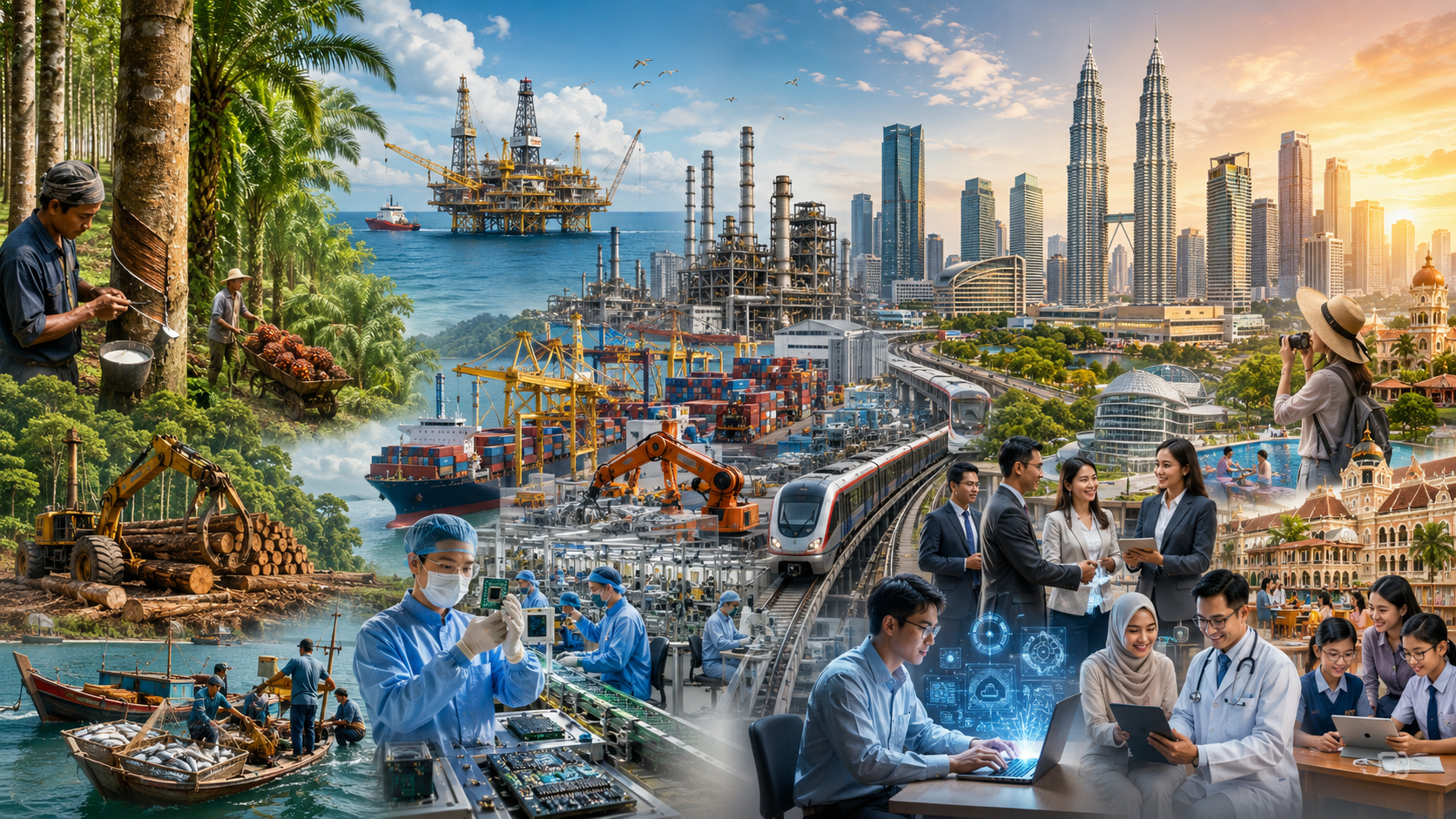
Malaysia is one of Southeast Asia’s most dynamic economies, shaped by a strong natural resource base and a long-term strategy of economic diversification. Since gaining independence, the country has moved from being heavily dependent on primary commodities to becoming a more industrialized and service-oriented economy. This transformation has helped Malaysia build resilience, attract foreign investment, and improve living standards.
Natural resources have played a major role in Malaysia’s economic development. The country is rich in petroleum, natural gas, palm oil, rubber, timber, minerals, and marine resources. Oil and gas remain among Malaysia’s most valuable assets, especially through offshore reserves in areas such as Terengganu, Sabah, and Sarawak. The petroleum sector has contributed significantly to government revenue, export earnings, and industrial growth. Petroliam Nasional Berhad, commonly known as PETRONAS, has become one of the country’s most important companies and a symbol of Malaysia’s energy strength.
Palm oil is another key pillar of Malaysia’s resource-based economy. Malaysia is one of the world’s largest producers and exporters of palm oil, supplying markets in Asia, Europe, the Middle East, and Africa. The palm oil industry supports millions of jobs, including smallholders, plantation workers, transport operators, and processing companies. It is used in food products, cosmetics, detergents, and biofuels. However, the industry also faces environmental concerns, especially related to deforestation, biodiversity loss, and land use. Because of this, Malaysia has promoted sustainability standards to improve the global image of its palm oil sector.
Rubber was historically one of Malaysia’s most important exports. Although its role has declined compared to palm oil and petroleum, rubber remains relevant, particularly in manufacturing. Malaysia is a leading producer of rubber-based products such as medical gloves, condoms, industrial components, and automotive parts. The global demand for healthcare products has shown how traditional resources can be transformed into higher-value manufactured goods.
Despite the importance of natural resources, Malaysia recognized early that depending too much on commodities could be risky. Commodity prices often fluctuate due to global demand, geopolitical tensions, and weather conditions. To reduce this vulnerability, Malaysia pursued diversification by expanding manufacturing, services, tourism, finance, and technology. The manufacturing sector became a major engine of growth, especially in electronics, electrical products, machinery, chemicals, and automotive production.
The electrical and electronics industry is one of Malaysia’s strongest sectors. The country is deeply connected to global supply chains, particularly in semiconductors, consumer electronics, and electronic components. Penang, often called the “Silicon Valley of the East,” has attracted many multinational companies and skilled workers. This sector has helped Malaysia move beyond raw material exports toward higher-value production.
Services have also become increasingly important. Banking, Islamic finance, education, healthcare, logistics, and digital services contribute significantly to national income. Malaysia is a global leader in Islamic finance, supported by strong regulation and international demand for Shariah-compliant financial products. Tourism also contributes to the economy by attracting visitors to Kuala Lumpur, Penang, Langkawi, Malacca, Sabah, and Sarawak.
Malaysia’s economic journey shows the importance of balancing natural resource wealth with diversification. Resources such as oil, gas, palm oil, and rubber provided the foundation for growth, while manufacturing and services created broader opportunities. The country’s future success will depend on innovation, sustainability, skilled labor, and the ability to compete in high-value industries while managing its natural resources responsibly.
