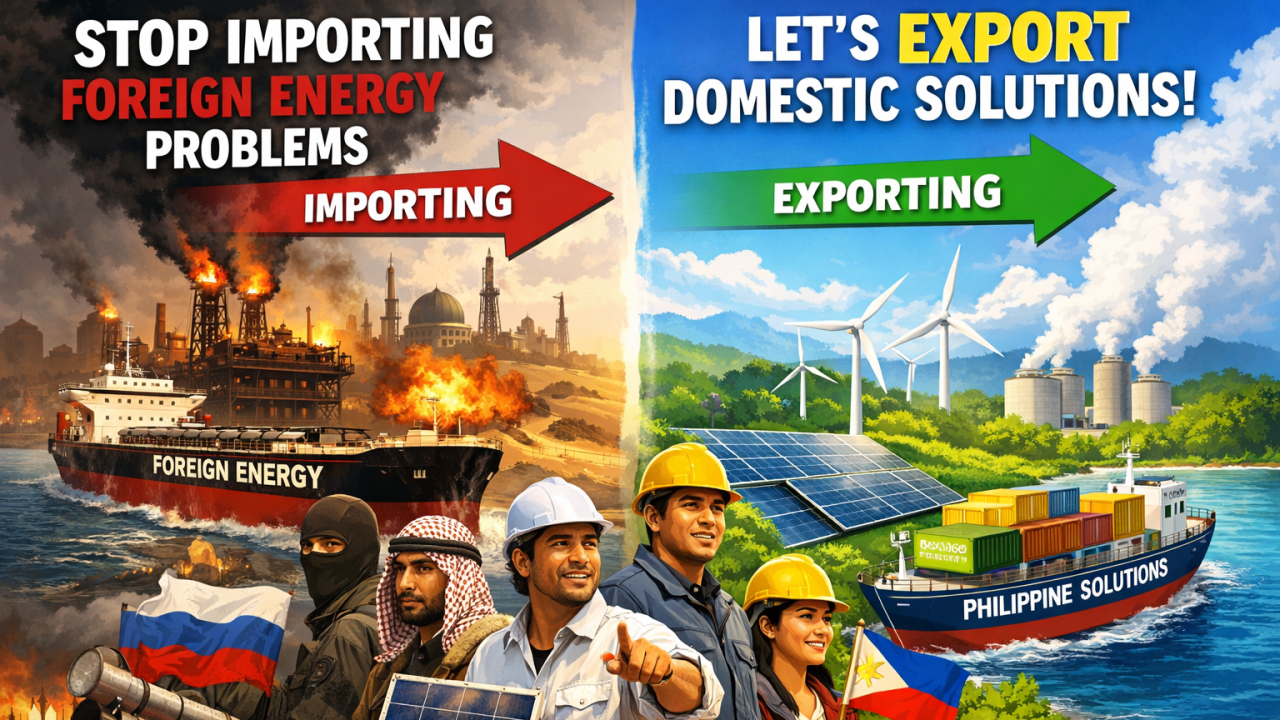
As a proud member of the Filipino business community, I’m committed to our nation’s progress. I’ve been thinking about how we can break free from risky dependencies on foreign energy supplies that expose us to global volatility, price spikes, and supply disruptions. The Philippines imports nearly all its crude oil (around 98% dependency), relies heavily on coal from Indonesia (98% of our coal imports in recent years), and faces tight aviation fuel stocks that have recently dipped into concerning territory amid international tensions.
Can’t we flip the script? Instead of importing foreign energy problems, let’s develop and export domestic solutions. This will help by creating jobs, building resilience, and positioning the Philippines as an energy innovator in Asia.
Here are the three concrete actions I urge our government to prioritize:
1. Achieve True Energy Independence by Scaling Domestic Oil and Gas Development—Building on Malampaya’s Success
Malampaya has been a national success story for natural gas, powering much of Luzon’s electricity for years. The recent breakthrough discoveries are even more exciting: In January 2026, President Marcos announced a major new gas find at Malampaya East-1 (MAE-1)—the first significant discovery in over a decade which was followed by strong progress on Camago-3 and other Phase 4 wells. First gas from these new developments is on track for Q4 2026, with potential to boost output by ~30% and extend the field’s life significantly.
This is proof that focused investment and private-sector execution (shoutout to Prime Energy and the consortium) deliver results. But we can’t stop at gas. Our oil picture is far more vulnerable: Daily consumption runs 450,000–487,000 barrels, with proven reserves stagnant and domestic production minimal. We must aggressively expand exploration and development for both oil and gas across our EEZ. By accelerating service contracts, offering better incentives to investors, and protecting these assets.
Imagine a Philippines where domestic production covers a growing share of our needs. It would stabilize prices, create thousands of high-skill jobs, reduce our massive import bill, and strengthen national security and our falling Peso. Let’s treat energy independence as a national priority, not an afterthought.
2. Ramp Up Local Power Production Through Waste-to-Energy Incineration Plants—Far Smarter Than Importing More Coal
Why keep shipping in millions of tons of coal from Indonesia when we can turn our own waste into power right here at home? Modern waste-to-energy (WTE) incineration plants with advanced emissions controls are proven, scalable, and a triple win: They solve our chronic garbage crisis, generate clean baseload electricity, and cut landfill use dramatically.
We’re already moving in the right direction with the first large-scale WTE facility advancing in New Clark City (600 metric tons of waste per day or roughly 12 MW of power, P4 billion investment by a Filipino-Indian consortium). The Department of Energy is auctioning more projects targeting ~170 MW, with pioneer incentives for projects online by 2028. Cities like Manila (Smokey Mountain) and others are exploring similar initiatives.
Compare that to our coal reality: Indonesia supplies the vast majority of our imports, leaving us exposed to export policy shifts or price volatility. WTE uses local feedstock (our own trash), creates local jobs in construction/operations, and supports our renewable energy goals without the import dependency or transport emissions of coal.
The government should fast-track permitting, provide clear incentives under the Green Energy Auction program, and mandate partnerships between LGUs and private developers. This isn’t just energy…it’s the circular economy leadership we can export as a model to other developing nations (as learned from Japan and Sweden).
3. Address the Aviation Fuel Vulnerability by Building a Domestic Sustainable Aviation Fuel (SAF) Industry from Our Biomass
Our fuel reserves tell a stark story. As of late March 2026, total petroleum product stocks (including jet fuel) stood at around 50–51 days…better than the recent low of ~45 days but still razor-thin for an import-dependent nation. Jet fuel has been repeatedly flagged as especially tight, with airlines and the DOE monitoring closely amid global disruptions. Aviation is critical to tourism, OFW travel, and connectivity in our archipelagic country, yet we’re one major supply shock away from disruptions.
The solution? Stop importing the problem and produce the solution here. The Philippines has abundant biomass feedstocks, rice straw/husks, coconut waste, sugarcane bagasse, cassava residues, and more. Studies show all have excellent potential for low-carbon-intensity SAF via proven pathways like FT-SPK or HEFA (if interested research these different methods). We already have airline interest (Cebu Pacific and PAL have run trials and set targets like 5% SAF by 2030), government engagement via the National Biofuels Board and BOI, and early MOUs for projects. Southeast Asia as a whole (with the Philippines well-positioned) could become a global SAF hub.
The government should:
Invite investors with clear incentives and streamlined approvals for SAF biorefineries. Set blending mandates and fiscal support (tax credits, offtake guarantees). Leverage our agricultural strengths to create a new export industry. This would secure our skies, cut emissions, generate rural jobs, and turn biomass “waste” into high-value fuel we could even sell regionally.
These aren’t radical ideas, most of my colleagues find them practical, build on existing momentum (Malampaya, WTE auctions, SAF studies), and align with our energy transition goals. By acting decisively, we stop importing vulnerability and start exporting Philippine ingenuity: secure energy, sustainable power, and green fuel.
This press release has also been published on VRITIMES
