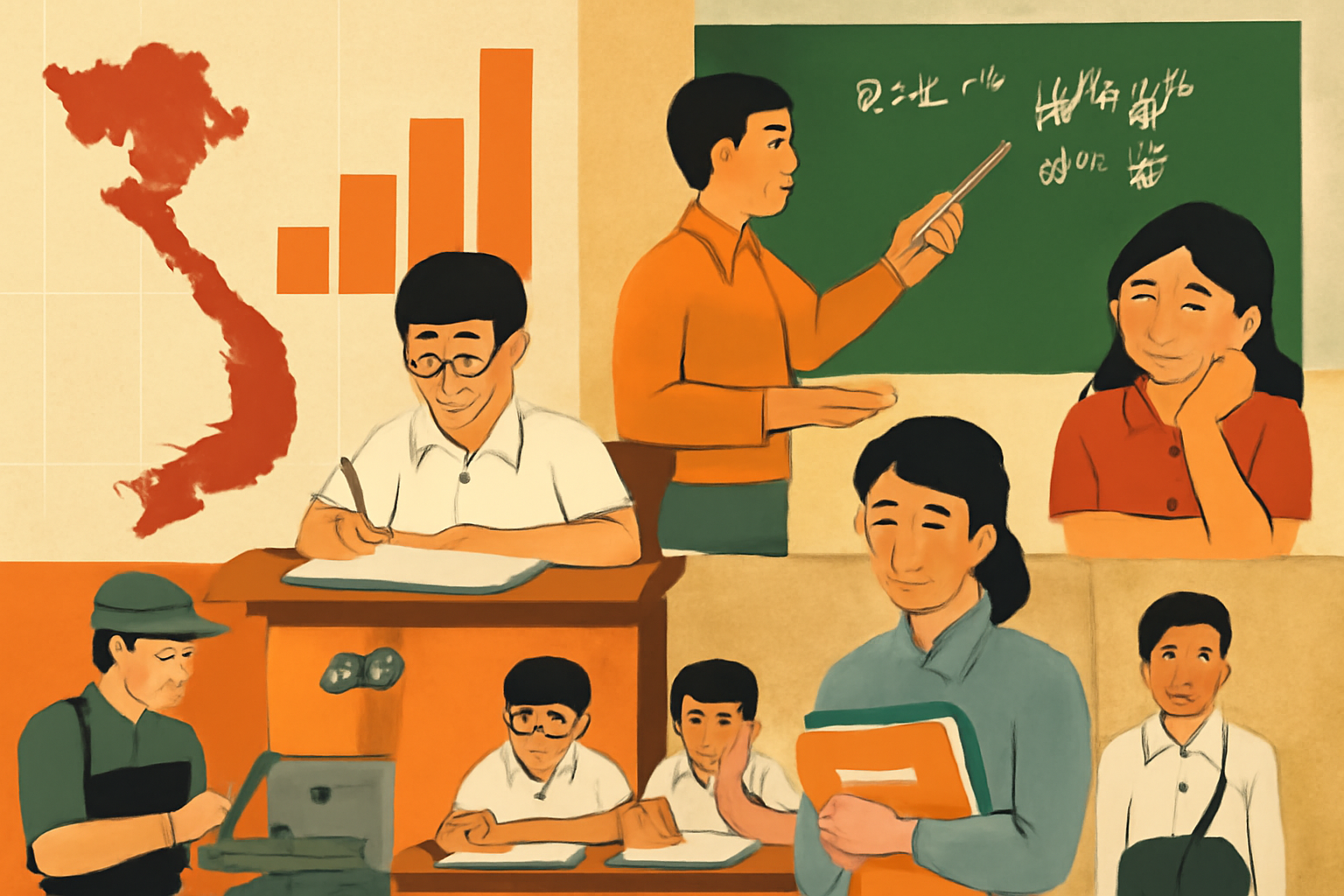
Vietnam has made significant progress in the field of education, achieving impressive results on the international stage. The country’s education system has evolved through a series of reforms that have helped improve access to education, increase the quality of learning, and align with global standards. However, there are still significant obstacles that need to be overcome.
Progress
One of the key achievements of Vietnam’s education system is its high literacy rate, which stands at around 94%. This success is largely due to the government’s strong commitment to universal education. Primary and secondary education are compulsory, and the government has made significant investments in expanding access to education, particularly in rural areas.
Vietnam has also made great strides in terms of educational outcomes. Vietnamese students consistently perform well in international assessments such as the PISA tests. In particular, Vietnam has outperformed many countries in mathematics, science, and reading comprehension, despite the relatively lower levels of public spending on education compared to other nations.
Moreover, the country has made notable advancements in vocational education and training (VET). The government has focused on developing a skilled labor force by offering vocational programs that cater to the needs of the country’s growing economy. This emphasis on practical, hands-on learning has been instrumental in addressing issues related to youth unemployment and skills shortages in key industries.
Obstacles
While Vietnam has achieved much, there are several challenges that need to be addressed. One of the most significant issues is the continued reliance on rote memorization. This method of learning, which emphasizes memorizing facts rather than understanding concepts, has been criticized for stifling creativity and critical thinking. Although students perform well on standardized tests, many struggle to apply their knowledge in real-world situations.
The gap between urban and rural education quality is another major issue. Students in rural areas face numerous challenges, including fewer resources, less access to well-trained teachers, and outdated learning materials. This creates a situation where urban students have a distinct advantage, leading to an imbalance in educational opportunities across the country.
Additionally, there is a shortage of qualified teachers, particularly in rural regions. Despite efforts to increase the number of teachers, many educators lack the necessary training and professional development to effectively teach in the modern classroom. This shortage has an adverse impact on the quality of education and highlights the need for greater investment in teacher training.
Conclusion
Vietnam’s education system has made tremendous progress, particularly in terms of literacy rates and international academic performance. However, challenges remain, especially in the areas of teaching methods, regional disparities, and teacher training. To ensure continued success, Vietnam will need to address these obstacles and continue to adapt its education system to meet the needs of a rapidly changing global economy.
